Healthy inventory starts with a commercial question: what do we expect to sell, when and under what conditions? The answer needs to become a purchasing plan that suppliers can deliver and the company can finance.
Inventory policy connects these plans. It defines the availability to support for each product category, how much inventory is acceptable and when to intervene. Without these rules, decisions are driven by emergencies, purchasing discounts or forecasts that no longer reflect the market.
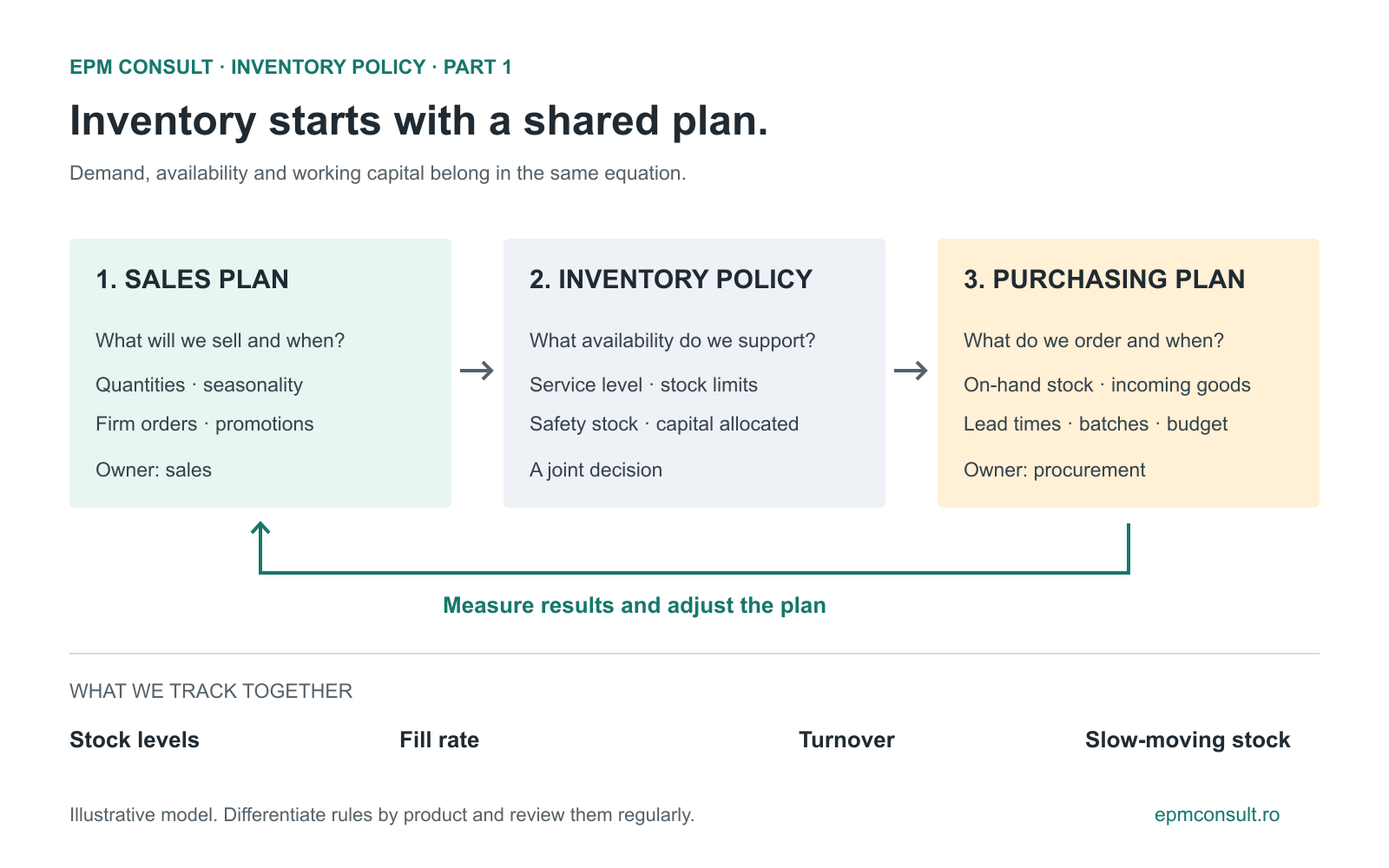
1. Three tools with different roles
The sales plan sets out what the commercial team intends to achieve. For inventory planning, the sales target must be supported by a realistic demand forecast. A 20% growth target alone does not justify buying 20% more goods. Identify the assumptions behind the growth: new customers, contracts, promotions, wider distribution or price changes.
Inventory policy sets the rules: products held permanently, products purchased to order, target service levels, stock limits and replenishment conditions. Rules differ according to contribution, demand predictability, criticality and supply.
The purchasing plan turns demand and rules into quantities and dates: what to order, how much, from whom and when it must arrive. It considers available inventory, reservations, open orders, lead times, minimum quantities and budget.
2. What the commercial team needs to provide
A value-based plan helps budgeting but is insufficient for deciding product quantities. For important items, specify units and relevant periods: weeks for fast or variable demand, months for broader planning.
Required inputs include:
- Forecast quantities by product or category and the expected selling period.
- Seasonality, promotions and projects that change the normal demand pattern.
- Firm orders and sales opportunities, shown separately so possibilities are not treated as certainties.
- New products, discontinued items and possible substitutions.
- Customer availability requirements and acceptable delivery times.
- Forecast assumptions and the person responsible for updating them.
History is a comparison baseline, not the only source. Sales during stock-outs can understate actual demand; an exceptional order can have the opposite effect. Discuss these situations before extrapolating.
3. What procurement checks before ordering
Procurement checks whether the plan can be executed. Stable demand and a fast supplier call for different rules from unpredictable deliveries or large minimum order quantities.
For each relevant category, check:
- Usable inventory, excluding damaged, blocked or non-conforming goods.
- Reserved quantities and unfulfilled customer orders.
- Open purchase orders and realistic arrival dates.
- End-to-end lead time: processing, production, transport and receipt.
- Supplier lead-time variability, not just the contractual lead time.
- Minimum quantities, pack multiples, storage capacity and shelf life.
- Purchase cost and available capital.
Goods arriving too late cannot resolve a shortage in the planned period. Check the calendar, not just monthly totals.
4. The pillars of inventory policy
| Pillar | Decision supported | What to monitor |
|---|---|---|
| Inventory level | How much should we hold and when should we replenish? | Units, value, days of supply and category limits. |
| Fill rate | What proportion of demand do we fulfil under the promised conditions? | Units, lines or orders fulfilled; specify the method and measurement deadline. |
| Inventory turnover | How quickly does invested capital cycle through stock? | Cost of goods sold divided by average inventory at cost, for the same period. |
| Slow-moving stock | Which items consume capital without sufficient movement? | Age, last sale, coverage and realistic future usage. |
Consider the pillars together. Reducing inventory can improve turnover while hurting fulfilment. Higher availability may require more capital. The policy sets the acceptable trade-off for each category.
ABC helps prioritisation but does not determine policy on its own. A C item may be critical to a customer or equipment operation. An A item with unpredictable demand needs different protection from an A item with regular usage.
5. A simple replenishment calculation
Assume forecast demand of 300 units over the next 30 days, a 20-day supply lead time and a review every 10 days. In a periodic-review model, the protection period is 30 days: lead time plus the interval until the next review.
For this example, demand is uniform and all incoming quantities arrive on time:
| Element | Units |
|---|---|
| Forecast demand during the protection period | 300 |
| Illustrative safety stock | 60 |
| Target stock level | 360 |
| Existing usable stock | 140 |
| Confirmed incoming supply | 100 |
| Uncovered firm demand, deducted separately | 40 |
| Inventory position: 140 + 100 - 40 | 200 |
| Proposed order: 360 - 200 | 160 |
The 60 units of safety stock are a teaching assumption, not a universal recommendation. In practice, size the buffer using demand and delivery uncertainty together with the target service level.
The example assumes the forecast of 300 units is additional to the 40 units deducted separately. If firm orders are already included in the forecast, do not subtract them again. Counting the same demand twice leads to over-ordering.
Check the proposed 160 units against minimum quantities, packaging and budget. Assess any rounding by the surplus it creates. If the supplier ships in multiples of 100, an order of 200 needs justification rather than automatic acceptance.
6. One plan, clear responsibilities
Sales owns the demand forecast and explains deviations. Procurement owns supply feasibility and order execution. Finance and management set working-capital limits and monitor cash impact. Operations confirms usable stock, receiving and storage capacity.
Important decisions need an owner and a deadline: who approves promotional stock, who accepts a batch above the limit and who stops replenishing a slow-moving item?
7. How to review the policy
A shared monthly plan review is a starting point, with more frequent checks for important or volatile items. Adapt the cadence to the business and its lead times.
At each review, discuss forecast versus actual demand, stock-outs, supplier delays, surplus and orders that can be adjusted. Look for forecasts that are repeatedly too high or too low.
Reassess the policy when demand, suppliers, lead times, prices or the product lifecycle change. Procurement must hear about a cancelled promotion before the goods are dispatched.
8. A practical check for your business
For your main product categories, can you explain:
- Which commercial forecast supports the inventory?
- What fill rate do you target and how do you calculate it?
- Which period must the inventory cover?
- How much capital are you willing to tie up?
- What triggers an order and what stops it?
- Who intervenes when forecast sales do not materialise?
A useful policy makes these answers clear and actionable. Inventory becomes the result of shared decisions, reviewed against market reality.
In part two: how much stock to hold and how to connect it to the fulfilment level promised to customers.
Does your inventory support your sales plan?
We can review the data and rules behind your inventory decisions.
Discuss your business