A warehouse can look orderly while hiding serious problems: blocked items, non-moving products, damaged stock, incorrect locations, partial packs or quantities that no longer match reality.
The item master can look complete while containing duplicate codes, discontinued products that remain active, outdated replenishment parameters and inventory that continues to generate purchase orders despite having no realistic demand.
Annual stocktake is the best opportunity for a thorough clean-up. It should not be the first time during the year when these problems are discovered. Inventory clean-up is a management routine, not only a counting exercise.
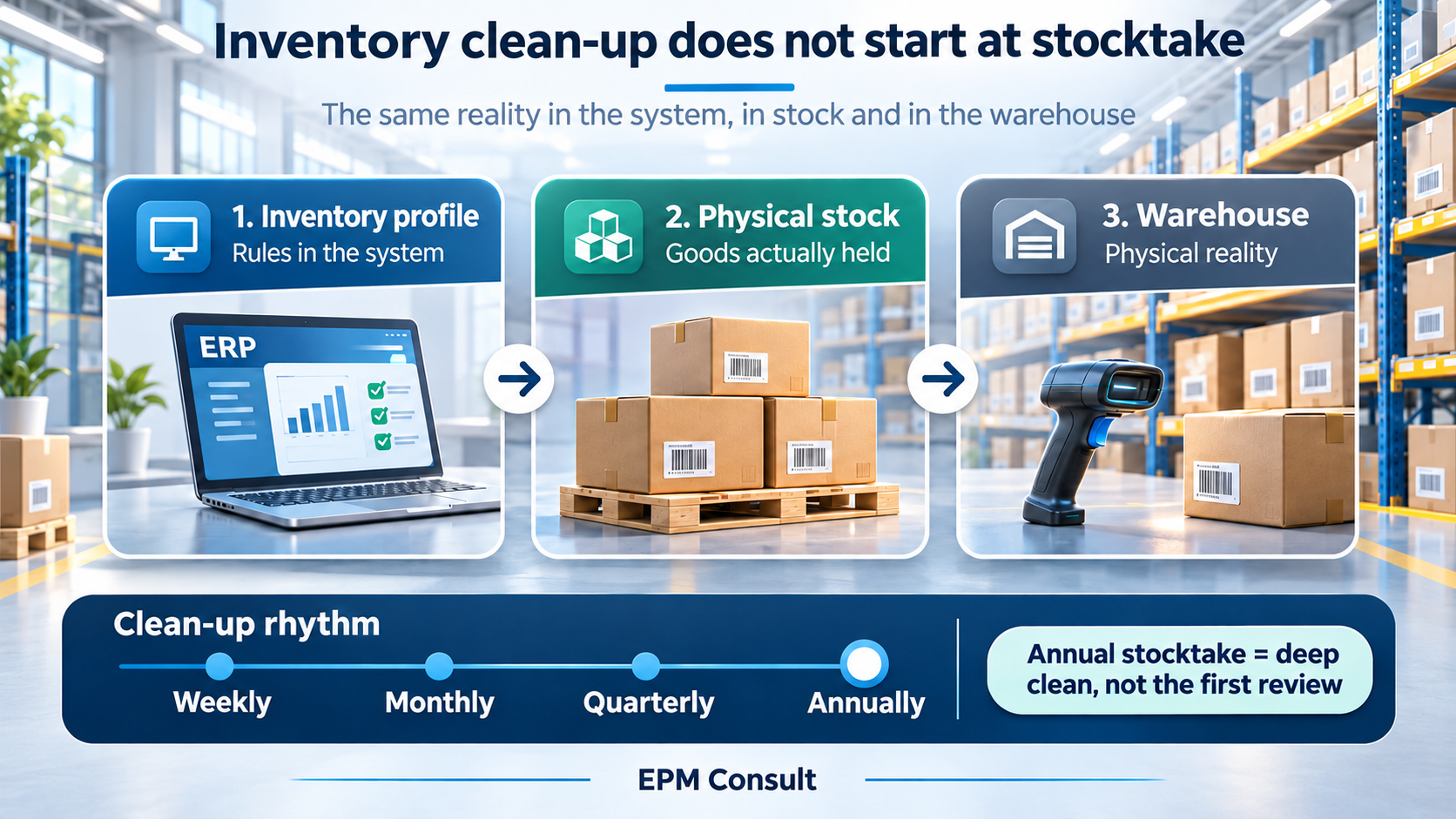
1. Clean up at three levels
The inventory profile
The inventory profile contains the rules used to hold and replenish an item. Review whether the item is still active, whether duplicate or replacement codes exist, whether min/max, reorder point and safety stock remain justified, and whether supplier lead time or minimum order quantity has changed.
Also confirm whether the product is seasonal, made to order, critical or being withdrawn, and whether automatic replenishment should be stopped. An outdated profile can purchase the same problem again after the warehouse has been physically cleaned.
Physical stock
Review the goods actually held: slow-moving and non-moving items, quantities above the justified requirement, blocked, damaged, expired or non-conforming products, informal reservations, partial packs, stock in the wrong location and discrepancies between physical quantity and the system.
Each situation needs a decision: retain, transfer, return, sell under controlled conditions, recondition, reclassify or remove according to the applicable procedures.
The warehouse
Physical clean-up is more than sweeping and arranging. Every product should be identifiable, accessible and stored under suitable conditions. Check labels, codes, units of measure, system locations, separation of usable and non-conforming stock, access to fast-moving items, temporary areas, damaged packaging and safety risks.
A clean warehouse reduces search time, picking errors, accident risk and stocktake discrepancies.
2. Annual stocktake is the deep clean
Annual stocktake forces the business to stop, count and compare physical reality with the records. Preparation should begin before counting:
- Separate usable, blocked, damaged and under-review inventory.
- Close or clarify unfinished receipts, transfers and deliveries.
- Correct unclear labels and locations.
- Prepare the list of non-moving items, repeated discrepancies and unjustified inventory.
- Assign an owner to every decision required after stocktake.
Stocktake should not end with a discrepancy list. It should end with a clean-up plan, owners and deadlines.
3. Do not wait for stocktake to find the problems
If a blocked item remains in the warehouse for a year, it occupies space, appears in reports, can influence ordering and consumes time at every check. A monthly or quarterly review can stop the problem before it grows.
| Frequency | What to review |
|---|---|
| Weekly | New blocked stock, damaged products, unclear locations, operational discrepancies and urgent exceptions |
| Monthly | Non-moving items, high-value slow stock, open orders that increase exposure and parameters that generate unsuitable replenishment |
| Quarterly | Withdrawn products, duplicate codes, remaining project or seasonal stock, classifications and profiles requiring updates |
| Annually | Full physical count, accounting and operational reconciliation, deep clean and a formal plan for all exceptions |
Adapt frequency to volume, risk and product type. Every review still needs a calendar, an owner and an expected outcome.
4. Example: how a problem grows until stocktake
Assume the year starts with 40 problem items valued at RON 60,000. Each month, an average of five more blocked, damaged or demand-uncertain items appears, at an average value of RON 1,500 each.
With no review during the year, stocktake may find:
40 items + 12 months × 5 items = 100 problem items.
The exposed value may reach:
RON 60,000 + 60 items × RON 1,500 = RON 150,000.
This illustrative example does not assume that the entire value is a loss. It shows how a small recurring problem can become a major stocktake issue when no decision is made. Monthly review identifies items sooner, stops replenishment and preserves better return, transfer or sales options.
5. Every problem item needs a decision
| Situation | Possible decision | Main owner |
|---|---|---|
| No demand but an open purchase order | Postpone, reduce or cancel within the contract | Procurement |
| Usable stock in one warehouse and demand in another | Justified transfer | Logistics and sales |
| Withdrawn or replaced product | Stop replenishment and create an exit plan | Product management / sales |
| Damaged or non-conforming stock | Isolate, inspect, return or remove under procedure | Warehouse and quality |
| Duplicate code or incorrect parameters | Correct the item master and ERP rules | Master data / procurement |
| Remaining seasonal stock | Consumption, transfer, offer or justified retention plan | Sales and procurement |
Document the decision, owner, deadline and intended result. Inventory write-offs, value adjustments or disposal must follow the relevant internal, accounting, tax and environmental procedures.
6. Clean-up session checklist
- Export inventory by SKU, location, quantity, value and last movement.
- Separate usable stock from blocked, damaged or non-conforming stock.
- Flag non-moving items and unjustifiably high coverage.
- Check open orders for every problem item.
- Compare system location with physical location.
- Identify duplicate, withdrawn or replaced products.
- Assign an action, owner and deadline to every exception.
- Stop replenishment where the profile is no longer valid.
- Track monthly what has been closed and what remains unresolved.
- Use the findings to prevent the same problems returning.
Conclusion
Real clean-up connects three realities: what the system says, what physically exists and what future demand still justifies. If one falls behind, the warehouse fills up again even after a well-run stocktake.
Annual stocktake remains the main deep-clean moment. A healthy business does not wait for it to discover more exceptions than normally managed items. Problems are reviewed regularly, decided on time and stopped before the next purchase order.
Does your inventory support your sales plan?
We can review the data and rules behind your inventory decisions.
Discuss your business