An item is not a problem simply because it is old. The problem starts when inventory is no longer justified by future demand. Review sales, usable stock and incoming deliveries together. This is an operational guide, not an accounting impairment policy.
1. Slow-moving, excess and non-moving stock are different
Slow-moving stock sells or is consumed less frequently or more slowly than the relevant expectation. Excess stock exceeds the justified requirement over the chosen horizon, including approved protection against uncertainty. Non-moving stock has had no sales or consumption within a defined period. These situations can overlap, but they are not interchangeable.
Do not apply a universal age threshold. Seasonal goods, critical spare parts and products with steady demand need different rules. Set the observation window around the sales cycle, replenishment lead time and the item's role. A warehouse transfer is not final customer demand.
2. Read the indicators together
At SKU and warehouse level, review usable stock, reservations, last sale, demand over comparable periods, the forward demand plan, inventory value at cost, open orders and expected receipt dates. Separate damaged, expired or blocked stock from usable availability.
Simplified months of coverage = usable stock / average monthly demand. Use consistent units and periods. If demand is zero, do not divide: review the item separately. For seasonal goods, new products or falling demand, use a monthly forward demand plan rather than an undifferentiated historical average.
Value at cost helps prioritise attention. It is not automatically cash that can be recovered: recovery depends on demand, price, selling costs and return options.
3. ABC sets priorities, not the full diagnosis
ABC based on annual consumption value or another explicitly chosen criterion helps focus attention. It does not, on its own, prove that a product is slow-moving. Combine economic importance with movement, required availability and the commercial outlook. Do not automatically remove C items: some support critical service or the sale of other products.
See also ABC classification and the inventory policy and purchasing plan.
4. Incoming orders can amplify the problem
An item has 240 usable units and expected demand of 20 per month. Simplified coverage is 12 months. An open order for 120 units would raise it to 18 months if received immediately, with no other movements. If it arrives in two months and demand remains 20 per month, projected stock on receipt is 240 − 40 + 120 = 320 units, or 16 months of coverage at that point.
These numbers are illustrative, not evidence of excess by themselves. Check future demand, contracts, criticality and approved policy. Ask why purchasing continues, not just how to sell what is already there.
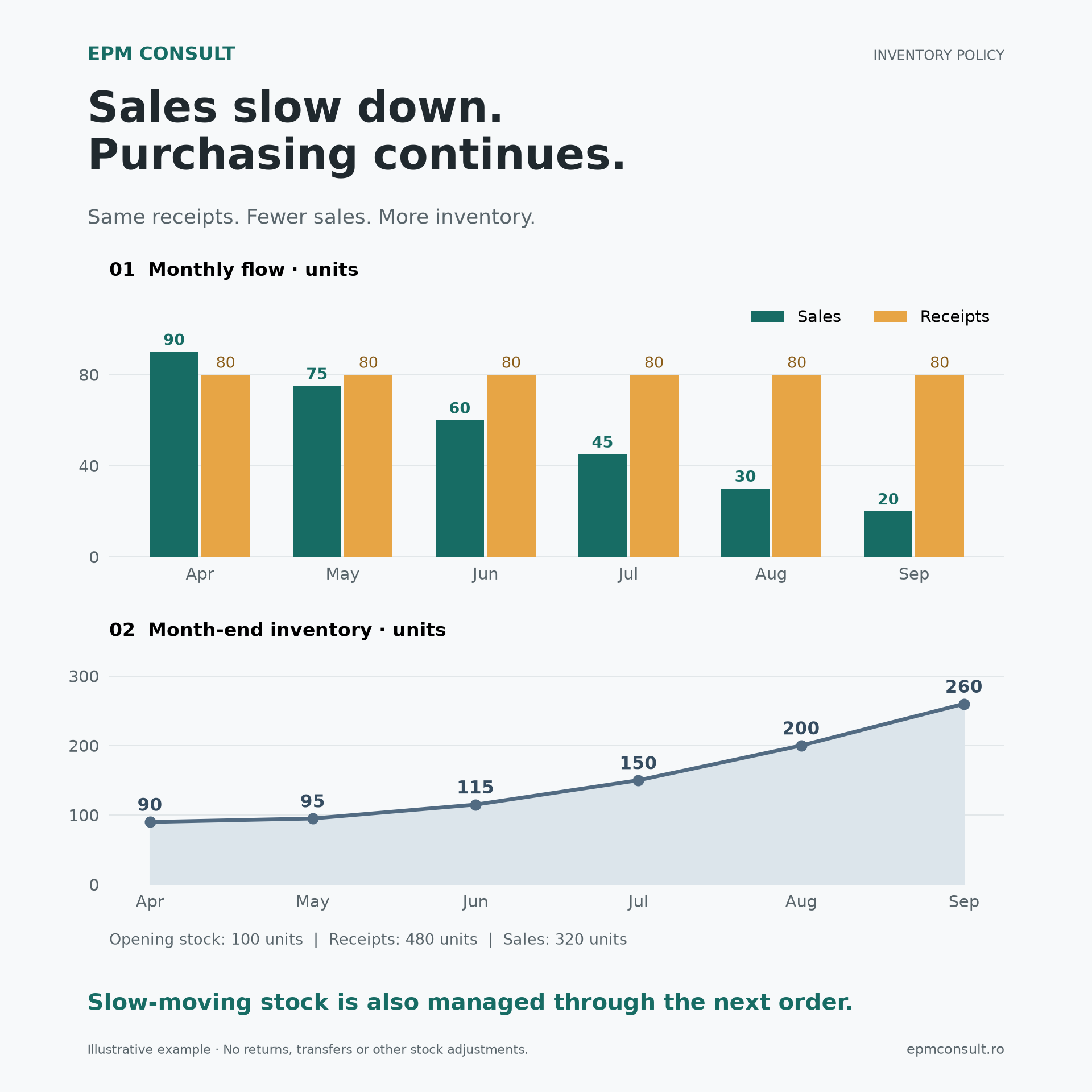
The chart uses a separate six-month example. Opening stock is 100; receipts are 80 each month; sales are 90, 75, 60, 45, 30 and 20. Closing stock is 90, 95, 115, 150, 200 and 260. It shows how inventory accumulates when purchasing is not adjusted to declining demand. This is a clear signal to review the ordering rate before inventory becomes slow-moving or underperforming.
5. Decisions before discounting
Review replenishment and whether open orders can be postponed, reduced or cancelled under the contract. Consider transfers to locations with real demand, negotiated supplier returns, targeted offers, validated technical alternatives or controlled portfolio withdrawal.
Discounting is an option where demand and margin justify it, not an automatic answer. Do not remove critical inventory without assessing the cost and risk of unavailability. For perishables, include remaining shelf life and expected consumption before expiry.
6. Give each action an owner and a review date
Sales validates demand. Procurement checks deliveries, supplier options and contractual constraints. Finance assesses value exposed and cash implications. Operations confirms physical availability and transfer options. Record the decision, owner, deadline and expected outcome. Weekly review of significant exceptions and monthly portfolio review can be a starting point, adapted to the business.
7. A working checklist
| Field | What to record |
|---|---|
| Item and location | SKU, description and warehouse |
| Availability | Usable quantity and reservations |
| Exposure | Value at cost; separate blocked stock |
| Demand | Last sale, comparable history and forward plan |
| Coverage | Calculation period and assumptions; no division by zero |
| Incoming stock | Open order quantities and expected dates |
| Context | Seasonality, criticality, shelf life and obligations |
| Decision | Action, owner, deadline and expected outcome |
At the next review, ask: which high-value items have weak demand? Which incoming deliveries increase exposure? Who will validate demand, and by when? Which orders can be adjusted? What outcome should the next review confirm?
Slow-moving stock is also managed through the next purchase order. Do not wait for the annual stocktake to reconnect buying with sales reality.
Does your inventory support your sales plan?
We can review the data and rules behind your inventory decisions.
Discuss your business