An inventory profile should not start with available warehouse space or the supplier's preferred order quantity. It starts with actual sales history, replenishment rhythm and the product's role in the portfolio.
For every item, the business should know what it normally holds, what is cycle stock, what protection is justified and when the next order should be released. That links inventory to demand rather than to urgency.
1. An inventory profile starts with sales history
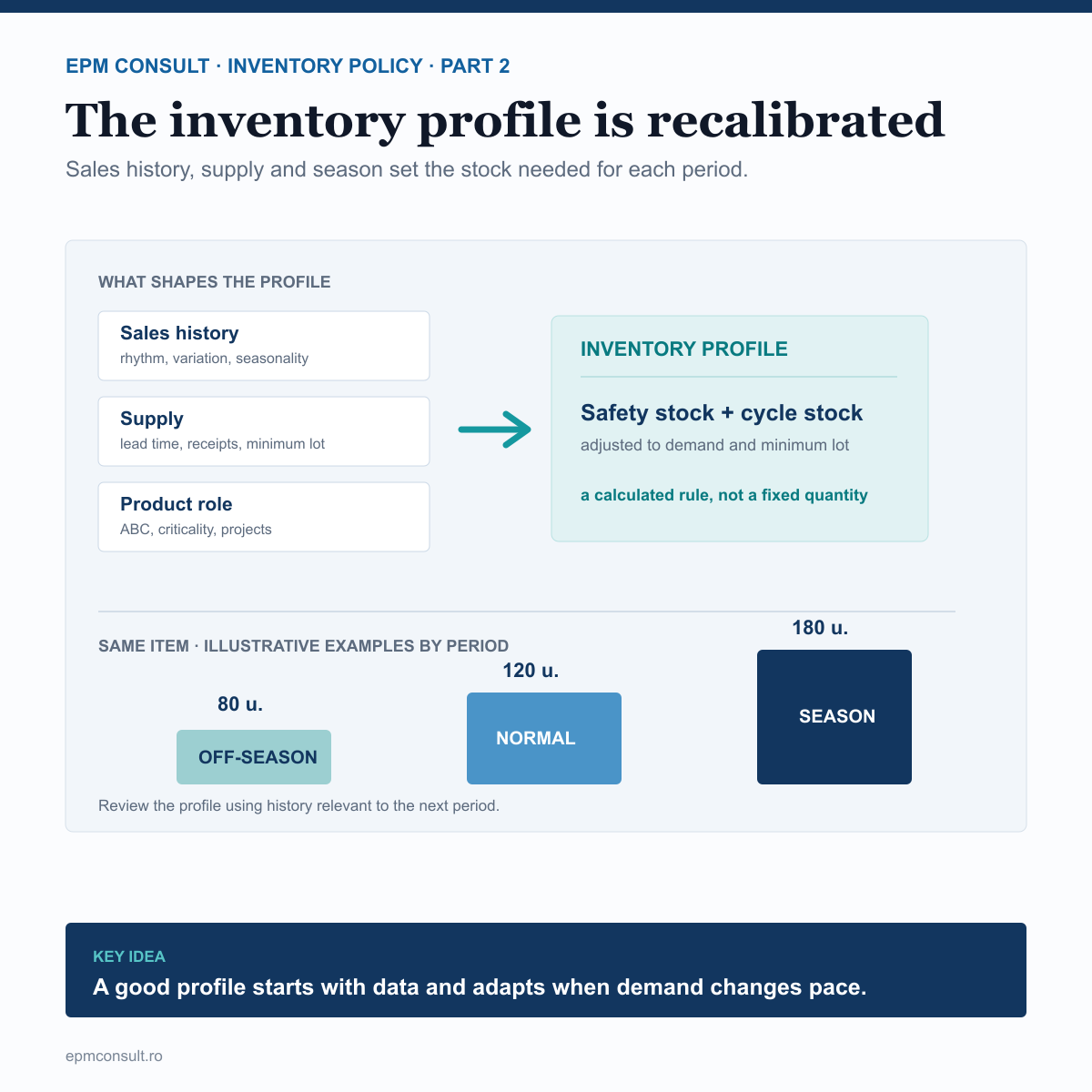
An inventory profile is the rule by which an item is maintained. Build it by SKU and warehouse from sales history, seasonality, receipt frequency, supplier lead time and recurring variation.
For seasonal or changing demand, use a monthly sales plan rather than an arbitrary average. For stable items, recent history can support a relevant average demand.
The practical question is: which inventory profile supports normal sales for this item without creating excess?
2. Cycle stock: what is needed between normal receipts
Cycle stock is the quantity needed to cover sales between two normal receipts. For non-technical readers, this is the stock needed for current turnover: the inventory that supports normal sales until the next receipt.
Cycle stock = expected demand until the next normal receipt.
Check sales history, actual delivery frequency, order quantities and open purchase orders. Forty days of supply may be excess for a supplier that reliably delivers in ten days, yet insufficient for a critical item with a 45-day lead time.
3. What belongs in the profile beyond cycle stock
| Component | Purpose | What to check |
|---|---|---|
| Cycle stock | Supports sales between normal receipts | Sales history, receipt rhythm, order quantity |
| Safety stock | Covers recurring demand or lead-time variation | Historical variation, supplier risk, criticality |
| Seasonal or project stock | Covers a defined event | Sales plan, depletion date, owner |
Safety stock should cover a known risk, not exist “just in case”. Seasonal or project inventory needs a review date; otherwise a temporary exception becomes permanent stock.
4. Different profiles by category
One profile for the whole portfolio puts capital in the wrong place. Start with ABC, then adjust for criticality, demand variation, supplier lead time and margin.
| Category | Possible inventory profile |
|---|---|
| A / critical | Frequently monitored cycle stock, justified safety stock and a regularly reviewed reorder point. |
| B / stable | History-based profile with periodic review of min/max and days of supply. |
| C / predictable or made-to-order | Low holding, buy to demand or a customer-accepted alternative. |
ABC is a starting point, not an automatic decision. A C item may be essential to a customer; an A item with highly variable demand may require a more carefully managed profile than an A item with stable usage.
5. One item, two profiles
Assume average sales of 10 units per day, a normal receipt every 20 days and a cost of RON 100 per unit. Cycle stock is 200 units.
| Profile | Cycle stock | Safety stock | Reorder point | Value |
|---|---|---|---|---|
| Stable profile | 200 units | 40 units | 240 units | RON 24,000 |
| Higher-variation profile | 200 units | 100 units | 300 units | RON 30,000 |
Reorder point = demand until receipt + safety stock.
The difference is 60 units, or RON 6,000. The question is whether observed variation in sales or supply justifies that capital.
6. Reviewing the profile
At the monthly review, check the following for important categories:
- Whether recent history confirms the profile or shows a change in demand.
- Whether cycle stock covers the actual rhythm between receipts.
- Whether safety stock covers a real and measurable risk.
- Whether the reorder point accounts for open orders and goods in transit.
- Whether coverage and tied-up capital remain justified by actual sales.
Order fulfilment remains the outcome measure: it shows how much demand was delivered as promised. It validates the inventory profile; it does not replace it.
Related guides
Does your inventory support your sales plan?
We can review the data and rules behind your inventory decisions.
Discuss your business