Inventory turnover shows how many times the capital invested in goods is renewed during a period. It is useful only when calculated consistently and read alongside availability and portfolio structure.
Higher turnover is not automatically better. It can reflect efficient inventory, but it can also hide recurring stock-outs. Low turnover may signal excess, yet it can be justified by seasonality, long lead times or critical products.
1. Calculate turnover using comparable values
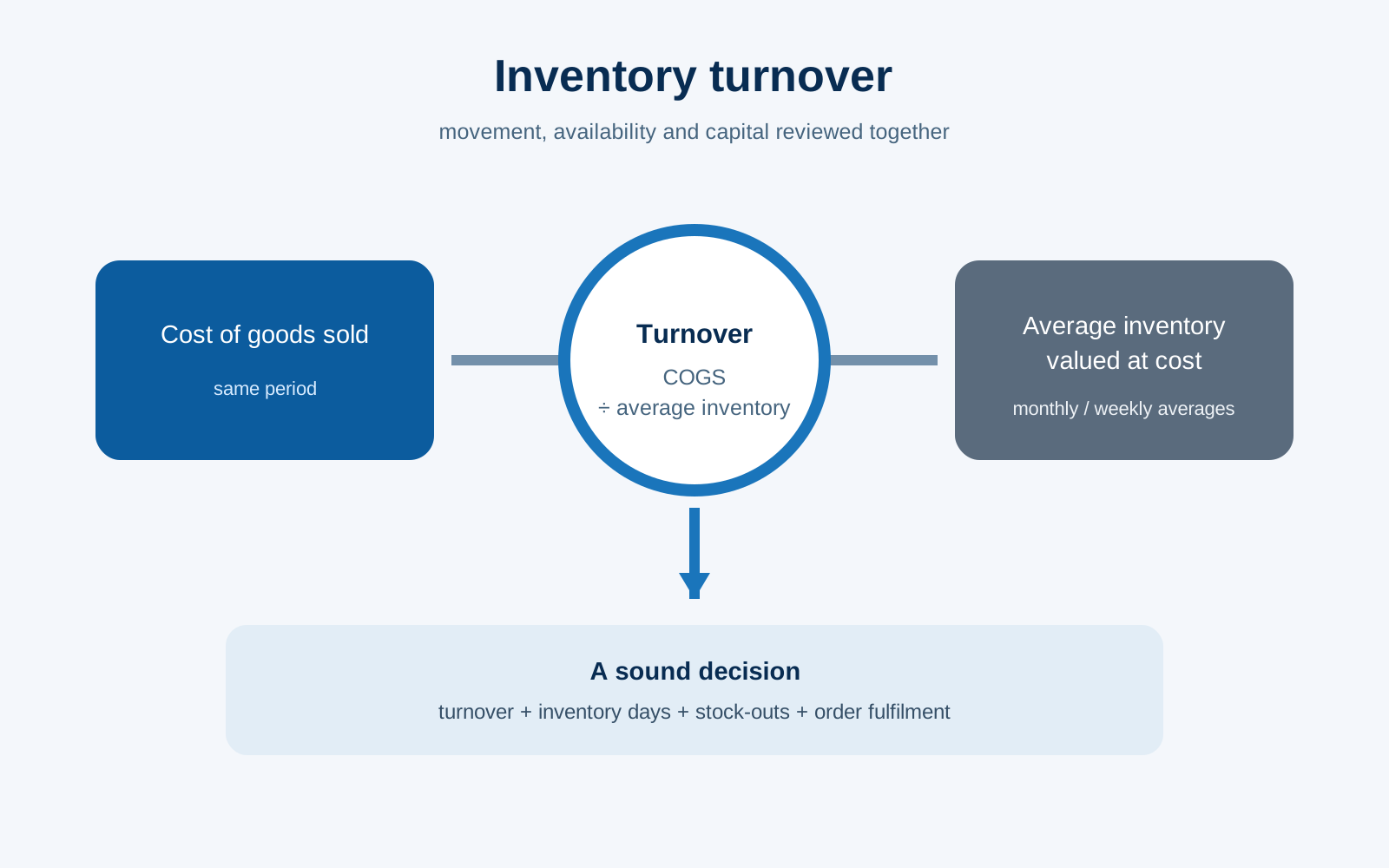
Inventory turnover = cost of goods sold / average inventory at cost.
The numerator and denominator must use the same valuation basis and period. Do not compare sales revenue with inventory at cost; the margin would distort the result.
For a simple period:
Average inventory = (opening inventory + closing inventory) / 2.
For seasonal or volatile portfolios, use monthly or weekly averages. Two snapshots can hide peaks inside the period.
2. Convert turnover into days for operational use
Inventory days = days in the period / inventory turnover.
Annual turnover of 6 gives approximately 61 inventory days: 365 / 6 = 60.8. This does not tell us whether 61 days are high or low. Compare the result with end-to-end lead time, receipt frequency, seasonality and product role.
Turnover describes movement achieved during a period; days of supply estimate how long inventory can support future demand. They complement rather than replace each other.
3. Do not apply the company average to every item
An overall average combines products with very different behaviour. Review turnover at least by category, ABC class, supplier and warehouse, then investigate the items driving the result.
| Situation | Possible meaning | What to check |
|---|---|---|
| High turnover and strong order fulfilment | Efficiently sized inventory | Demand and supplier stability |
| High turnover and frequent stock-outs | Insufficient stock or late replenishment | Lost demand, lead time, reorder point |
| Low turnover and stable demand | Excess or oversized batches | Minimum quantities, order frequency, safety stock |
| Low turnover and critical or seasonal item | Possibly justified inventory | Useful window, shortage risk and consumption plan |
4. Example: the same sales, different capital
Two categories each have annual cost of goods sold of RON 1,200,000.
| Category | Average inventory at cost | Annual turnover | Approximate inventory days |
|---|---|---|---|
| A | RON 200,000 | 6 times | 61 days |
| B | RON 400,000 | 3 times | 122 days |
Category B uses RON 200,000 more capital for the same cost-volume sold. That difference is not automatically releasable. Check minimum batches, seasonality, lead time, safety stock and items without realistic future demand.
If the analysis confirms that RON 50,000 supports neither demand nor approved protection, that amount belongs in an action plan. Do not present the entire difference as a savings promise.
5. Improve turnover through decisions, not general cuts
Turnover can improve through demand-aligned orders, negotiated batches, more frequent receipts, postponing unjustified orders, warehouse transfers and action on slow-moving items. Replenishment parameters must also change when demand or supplier lead time changes.
Uniform cuts can move the problem from the balance sheet to the customer relationship. Track turnover, inventory days, stock-outs and order fulfilment together.
6. Establish a review routine
Each month, compare the result with the previous period and with the same period last year where seasonality matters. Separate the effect of sales from changes in inventory and document approved exceptions.
Every significant deviation needs a decision, owner and deadline: which order changes, which parameter is recalibrated, which stock is transferred and which result will be checked next month.
Related guides
Does your inventory support your sales plan?
We can review the data and rules behind your inventory decisions.
Discuss your business