An inventory profile describes how an item is maintained. Order fulfilment describes the outcome the business wants for the customer. The two must be connected, but they are not the same.
A company can hold substantial inventory and still deliver poorly when cash is tied up in the wrong items. It can also hold carefully sized inventory while making a commercial promise that operations cannot sustain. Inventory policy should therefore state which availability outcome is expected, for whom and within what capital limit.
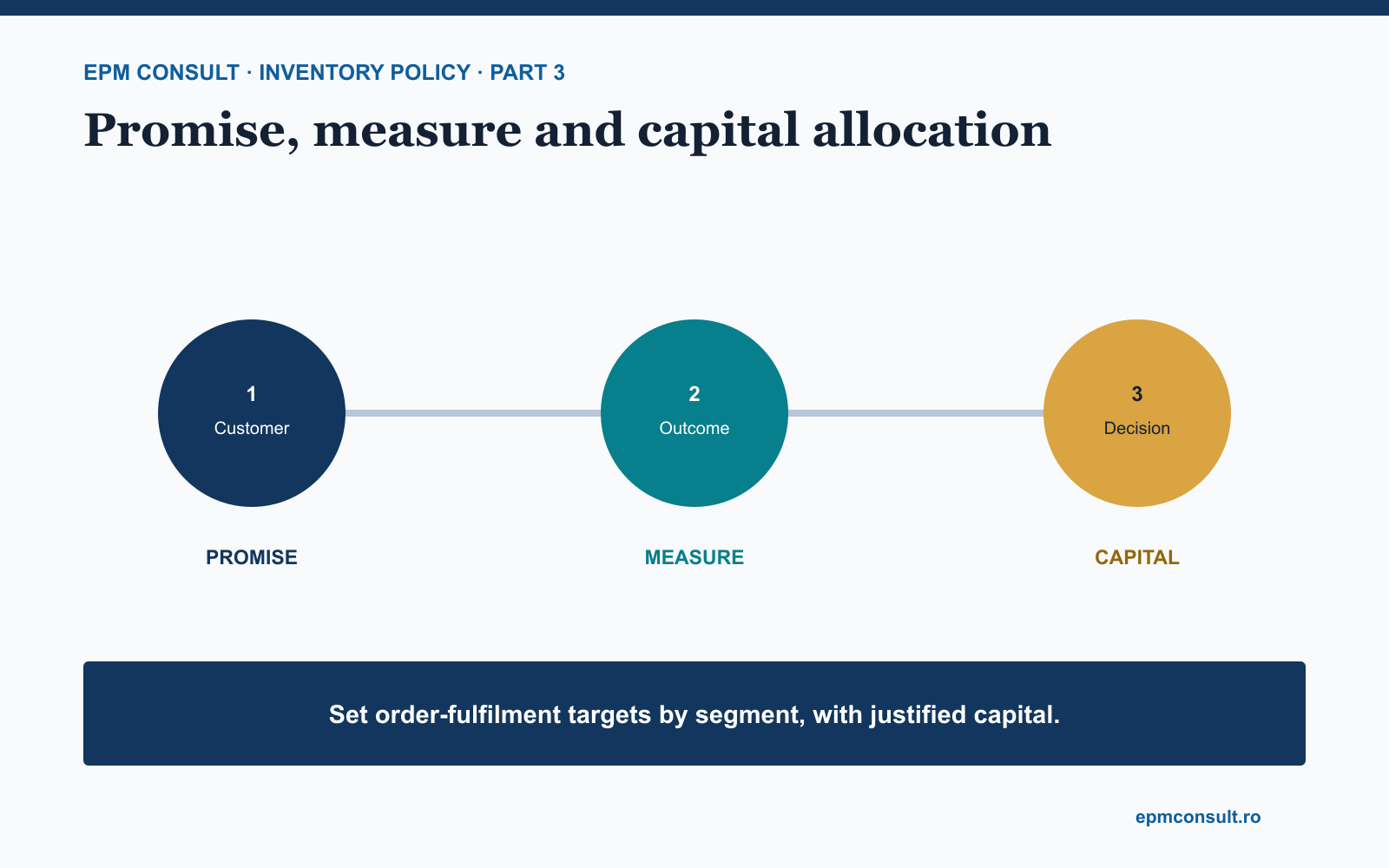
1. Define the promise before the percentage
A “high fulfilment target” is not a sufficient rule. The business must define a successful delivery in operational terms:
- the correct product;
- the requested quantity;
- the agreed location;
- the promised date or window;
- a complete delivery or an accepted partial delivery.
A measure is useful only when sales, procurement, logistics and finance interpret it consistently.
2. Do not mix the measures
Order fulfilment can be measured in several ways. Each answers a different question:
| Measure | Question answered |
|---|---|
| Unit fill rate | What proportion of the requested quantity was supplied from stock? |
| Complete order lines | How many order lines were supplied in full? |
| Complete and on-time orders | How many orders met the entire promise? |
| Stock-out rate | How often did demand find the item unavailable? |
The same operation can look different under each measure. A partially supplied order can produce a high unit fill rate and still be an unfulfilled customer order.
3. Set targets by segment, not one percentage for the portfolio
A single target for every item moves capital into areas where customer value may be low. Differentiate targets using at least four criteria:
- contribution to sales and margin;
- impact of a stock-out on the customer or operation;
- predictability of demand and supply;
- availability of an acceptable substitute.
A low-value item may require very high availability if it keeps equipment operating. A high-value item purchased only for projects may be held only against a firm order.
4. Days of supply are an outcome, not the final target
Days of supply show how long usable inventory can support expected demand:
Days of supply = usable inventory / average daily demand.
Read this measure alongside end-to-end replenishment lead time, demand variation, open orders and the commercial calendar. Two products with the same coverage can carry very different risks.
The aim is not to maximise days of supply. It is to achieve the chosen fulfilment outcome with justified capital.
5. Example: assess improved fulfilment in financial terms
Assume a category with annual sales of 12,000 units, an average margin of RON 35 per unit and average inventory valued at RON 300,000.
| Option | Target fulfilment | Estimated additional capital | Additional sales protected | Estimated additional margin |
|---|---|---|---|---|
| Current policy | 94% | RON 0 | current baseline | current baseline |
| Proposed policy | 97% | RON 75,000 | 360 units/year | RON 12,600/year |
The additional margin is 360 × RON 35 = RON 12,600 per year. The example does not prove that 97% is automatically good or bad. It requires management to compare the commercial benefit with the additional RON 75,000 tied up, financing cost, obsolescence risk and the importance of the customers protected.
The decision may be justified for one strategic category and not for another. Targets therefore belong at segment level.
6. Decide who sets and reviews the target
Procurement should not set order-fulfilment targets alone:
- sales defines the promise and the impact of shortages;
- procurement explains lead time, order quantities and supplier risk;
- logistics validates usable inventory and operating capacity;
- finance measures capital and its cost;
- management approves exceptions and priorities.
The monthly review should compare the target, actual outcome and capital used. When fulfilment falls, the answer is not automatically “buy more”. First check whether the cause is the inventory profile, supplier performance, stock distribution, inaccurate data or an unaligned commercial promise.
Availability-promise checklist
- What exactly counts as fulfilled demand?
- Which measure do we use and at what level?
- Which target applies to each product or customer segment?
- How much capital is required for the chosen target?
- Who approves exceptions?
- When do we review the target against actual results?
Inventory policy becomes useful when it converts “we should have stock” into a measurable choice: what we promise, what it costs and who owns the outcome.
Related guides
Does your inventory support your sales plan?
We can review the data and rules behind your inventory decisions.
Discuss your business